

Welcome back, Beaty Beat readers! I took the past several months off from this space because I got married to Jack Brownfield in July. Coupled with a move to Pittsburgh this past winter, 2026 has been quite the momentous, joyful, overwhelming year. I plan to resume writing here at least once a month. I’m grateful for all of you for sticking around during the hiatus!
This summer marked 20 years since I graduated from Calvin University. The summer after graduation, I experienced a mental health crisis that was bewildering and scary. I’ve shared here and there about it before, and have been thinking about it recently, because of the contrast between this summer and that summer 20 years ago. There were moments in summer 2006 where I didn’t know if I would make it this far. I am sharing that experience so that others may be encouraged to know they aren’t alone.
I have also been thinking about that season because of the most popular mental health advice on offer to Christians today. I’m glad it wasn’t available to me back then.
My Mental Health Scare
To my knowledge, there wasn’t a single event that sparked it. My senior year of college, I felt burnt out from studies and faced some normal anxiety about the upcoming post-college transition. My senior year started out with a general unease, what I then called a “darkness,” that grew acute after graduation.
The first sign that something was off was that I couldn’t sit still in one place. I couldn’t focus, so I couldn’t complete the research I needed to do for a summer fellowship at Calvin. I had insomnia most nights. Waking life had a feeling of unreality to it, like a gauzy curtain had fallen between me and everything else. I also had fleeting thoughts of self-harm, which scared me deeply.
I turned to the only source of healing I knew at the time: I went to church. A man prayed — how to say this — Pentecostally over me. While I’m sure he meant well, the intense praying made things worse, because it seemed he was praying for evil spirits in me to flee, and what did it mean that there might be evil spirits in me?
That I still felt so bad after the healing prayer surely meant I had some deep unconfessed sin. So I’d spend hours in the college chapel praying, journaling, and reading Scripture. I also began meeting weekly with a woman who had approached me on campus to start studying the Bible together. Later that summer, she and her family invited me to attend a ministry conference with them. The night before I was supposed to go, my mom, perhaps following a maternal instinct, did some research online and found that the group hosting the conference had a reputation for cult-like practices. I backed out last minute and drove to Ohio to be with my family instead, crying the whole drive home.
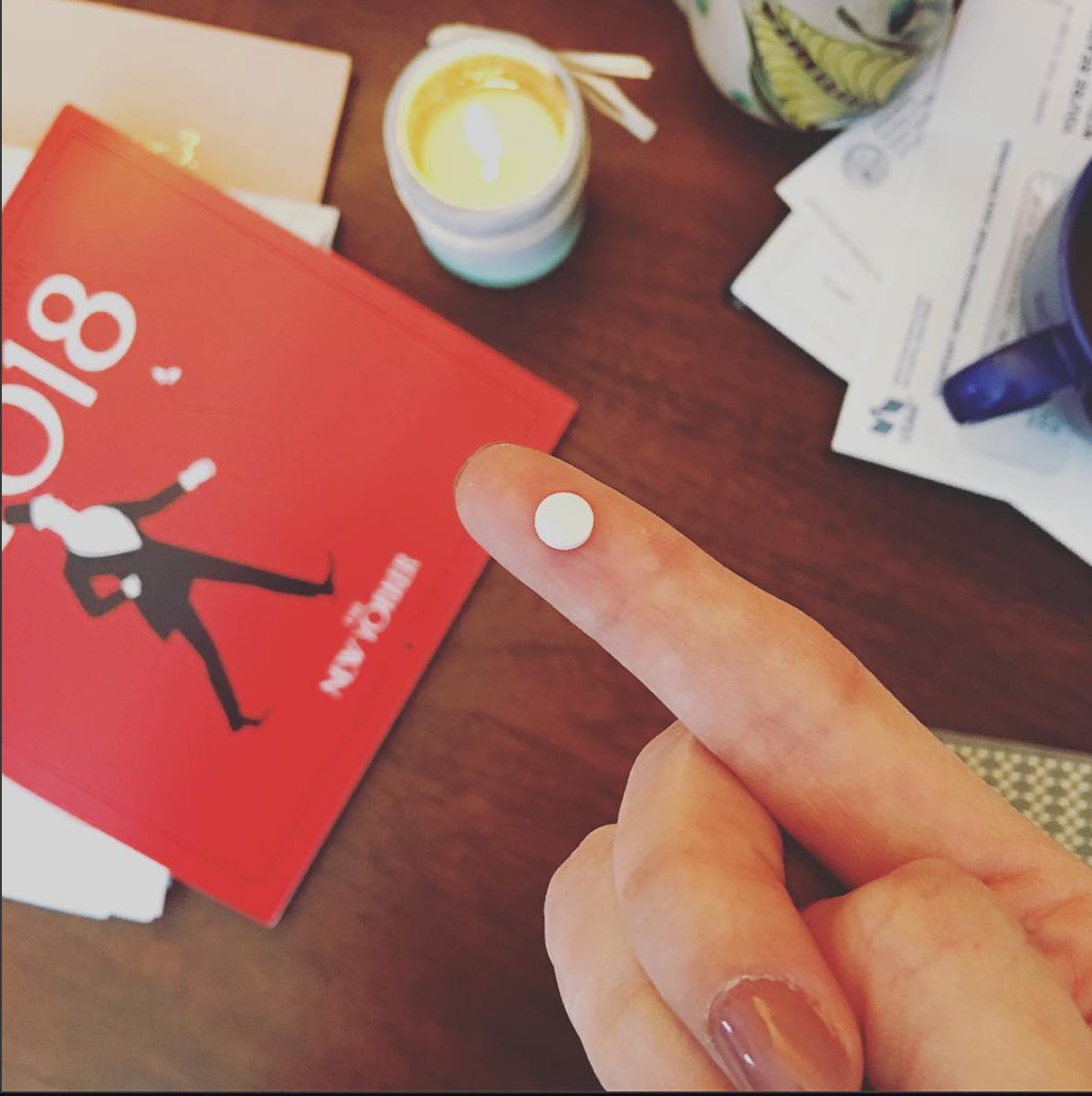
The clear turning point that summer came one afternoon when I felt so deeply unwell that I (finally!) walked to the campus clinic and spoke with a school nurse — a licensed medical professional. She clearly and compassionately explained that, based on the symptoms I described, my brain was severely low in serotonin (a neural chemical crucial for daily functioning and well being). She prescribed 20mg of Lexapro, commonly used to treat Generalized Anxiety Disorder. Within a few weeks of taking it, I started to feel well — like myself, like the fullness of the person God had intended me to be was being restored. I have been on this medication (albeit at a much lower dose) ever since.

Because of that pivotal summer, I have never wondered if taking Lexapro made me a less-than Christian. Of course it’s not a replacement for a vibrant spiritual life. Is someone who uses a crutch after surgery refusing God the chance to heal them? Is someone who applies basic health wisdom — like eating nutritious food, getting good exercise and sleep, drinking lots of water, and limiting screen time — disobeying God because there’s no single Scripture passage about getting enough fiber? (Counterpoint: There is a verse, Ezekiel 4:9, in which God commands the Israelites to take “wheat and barley, beans and lentils, millet and spelt” and make bread out of it. Sounds pretty fibrous to me.)
Christians’ concerns about medication and secular therapy arise out of a worldview that distrusts knowledge, wisdom, and authority outside the church — “the church,” of course, defined as a tiny sliver of the breadth and width of God’s people throughout history. Christian fundamentalism divides the world into good and bad and encourages adherents to white-knuckle their way to holiness through behavior modification programs offered as discipleship. It has created very anxious people.
Fundamentalism is the bedrock of the nouthetic or “biblical counseling” movement, begun by Jay Adams in the 1970s to counter what he saw as dangerous, secular therapeutic frameworks. Nouthetic counseling teaches that the Bible and only the Bible is the authority on all matters of life and faith, and that many mental health issues are at root about sin or spiritual malady. Counseling is the task of pastors and spiritual leaders, not licensed professionals who are credentialed and held accountable by a national association or state boards, as the latter adhere to “worldly” standards.
This narrow worldview is implied in this arrogant claim from the late John MacArthur in 2024:
There is no such thing as PTSD, there is no such thing as OCD, there is no such thing as ADHD. Those are noble lies to give the excuse…at the end of the day, to medicate people. And Big Pharma is in charge of a lot of that.
I recommend reading O. Alan Noble’s response to MacArthur, and Marissa Franks Burt to understand the biblical counseling movement (see here and here). Adams and his acolytes feature prominently in Burt’s and Kelsey Kramer McGinnis’s 2025 Brazos book, The Myth of Good Christian Parenting: How False Promises Betrayed a Generation of Evangelical Families.
As Burt notes, the biblical counseling movement encouraged pastors and spiritual leaders to take counseling into their own hands, that
they didn’t need fancy degrees, they didn’t need medical training, they didn’t need to listen to external sources of authority to address personal and relational problems; all they needed was the Word of God.
But sometimes, what suffering people need is more than a Bible verse; more than prayer time; more than confession of hidden sins. Saying this doesn’t undercut the authority of Scripture or the value of daily spiritual rhythms; rather, it acknowledges that humans are complex beings of mind, body, and soul — God gave us bodies and called them good! — and that caring for the body and the mind are just as crucial as caring for the soul. MacArthur’s statements are dangerous, potentially preventing Christians in acute distress from seeking the holistic care they need.
Which brings me to Jennie Allen.
Toxic Thoughts as Spiritual Warfare
Jennie Allen is a Bible teacher, best-selling author, and founder of the IF:Gathering women’s conference. In 2020 she published Get Out Of Your Head: Stopping the Spiral of Toxic Thoughts (WaterBrook). The book aims to help readers, primarily other Christian women, change their thinking as a way of finding peace and spiritual victory. As of early 2025, the book had sold 1.4 million copies, speaking to readers’ felt need to improve their mental well being. Allen is speaking at next week’s THINQ Media (formerly Q) conference on the topic “Resisting Intrusive Thoughts.” (Last year I wrote about Q’s ideological turn in recent years.)
Allen uses Romans 12:2 — “Do not be conformed to this world but be transformed by the renewal of your mind” — as the foundation for the book’s teaching, “Not only can our thoughts be changed, but we can be the ones to change them” (p. 22). What follows is a gloss on cognitive behavioral therapy (CBT) — a common therapeutic modality often described as “talk therapy” — through the lens of spiritual warfare. Allen writes, “The greatest spiritual battle of our generation is being fought between our ears” and, “Anxiety and depression and despair are ultimately spiritual attacks.”

Allen writes about her months-long battle with late-night despair and hopelessness, which she says started after a demonic attack at one of her speaking events in Little Rock. What turned the tide was fervent prayer with friends and deliberately replacing negative thoughts with true statements from the Bible. The possibility of clinical depression or anxiety (perhaps from managing a huge teaching ministry, conference, and book publishing schedule, all while being a devoted Christian wife and mother and looking picture perfect amidst it all?) is never considered. The problem is always only spiritual, so the solution must be too.
Allen clarifies in a sidebar early in Get Out of Your Head that mental illness is real and nothing to be ashamed of. She writes:
I am not suggesting that you can think your way out of mental illness. I am not. I have experienced seasons of anxiety so brutal that I was paralyzed. There are seasons when we need help in the form of counseling and medicine. But I hope to show you in the coming pages that in every season there is help that we can access for ourselves. Learning to think a single thought can help us all—those of us who struggle with mental illness and those of us whose struggles are of a different sort.
The rest of the book focuses on helping readers struggling with obsessive thoughts, rumination, or anxious spirals to choose to think different thoughts. This is the double-edged sword of so much self-help, including Christian self-help: Advice meant to be empowering is doubly disempowering when you can’t fix the problem before you.
Let me tell you how debilitating the following teachings from Allen would have been to me 20 summers ago:
“Every toxic thought, spiraling emotional cycle, and trap of the enemy we fall for somehow deep down involves a wrong belief about God.”
I must be struggling because this whole time I’ve believed the wrong things about God. I must spend hours focusing on my own thoughts (a disastrous move if you’re already in an anxiety spiral!) to correct the bad ones and replace them with good ones.
“Your mind is a battlefield, and you have a choice to take your thoughts and make them obedient to Christ. That is how you overcome spiraling thoughts, feelings of despair … we can control our thoughts.”
God and Satan are daily battling things out in my head? That feels really intense, like Satan is reading my thoughts. And I thought I was ‘saved,’ so why is this daily battle even occurring?
I can’t control my thoughts — including scary thoughts of self-harm, panic, and spiritual attack. Does that mean I’m not obedient to Christ?
Kate Willsey, a therapist, devoted a recent Instagram reel to unpacking Allen’s book from an integrated mental health perspective. She notes, “When your body already lives in hyper-vigilance, teaching it to be more vigilant does not produce freedom.”
For me, knowing there was something off in my brain chemistry was a gift. It meant there wasn’t something spiritually awful in me that was causing this awful season. By contrast, if I had heard that the problem stemmed from negative thought loops (inspired by Satan!) that I could fix with enough Christian devotional activity adds a burden of “try harder” to a nervous system already pushed to its limits.
Celebrity Pastors vs. Licensed Clinicians
Allen surely has the right motives — to help women break free in the same way she found freedom. But when it comes to mental health, right motives and evangelical bona fides aren’t enough to write and speak as a mental health guide for millions of readers and followers.
Allen isn’t the only platformed Christian writing on mental health, but without any mental health training, credentialing, or licensing. Other recent best-selling Christian books — Don’t Give the Enemy a Seat at Your Table, by Louie Giglio (Thomas Nelson); Every Thought Captive, by Kyle Idleman (Zondervan); and Winning the War in Your Mind, by Craig Groeschel (Zondervan) — address anxiety, depression, and negative thought patterns through the lens of spiritual battle and/or Scripture replacement technique. Giglio, Idleman, and Groeschel are the pastors of prominent megachurches. They are also top-selling book authors with significant social media platforms.


Here, I hold publishers responsible for asking high-profile pastors to teach on topics beyond their expertise. Naturally there’s an economic motive here: few people will buy a book from a licensed Christian therapist who isn’t a household name. But if Craig Groeschel wants to write about “healing your hurting mind,” well, we know pop psychology is a big nonfiction category, and we know books with Groeschel’s name on the cover sell. Publishers are right to want to sell books, but they also have an ethical responsibility to platform people who teach on sensitive topics with earned authority — authority that comes from years of training, credentialing, and accountability within an institution. It’s boring, but it’s true.
Rebekah Lyons, co-founder of THINQ Media and a friend of Allen’s, has shared often about her battles with anxiety. She came under scrutiny after comments at the 2018 IF:Gathering that sounded like her daughter’s panic attacks could be healed by prayer alone. Allen later clarified that IF supports medication and counseling and that mental illness isn’t a sin. Lyons continues to offer tips and solutions on combating anxiety through prayer and meditating on Scripture alone.
Just because you’ve experienced panic attacks doesn’t make you an expert on other people’s panic attacks. Personal storytelling is a way of connecting with an audience, of pulling back the curtain to reveal suffering to assure others they aren’t alone. Women’s vulnerability definitely “works” from a market perspective. But there’s a difference between, “I experienced this, this is my story” and “I experienced this so now I can expertly teach and guide you in your suffering.”
I’m grateful that mental health is less of a taboo in large swaths of the church. I’m also grateful there are many licensed clinical therapists who are Christians and who are teaching from credentialed authority and care: folks like Chuck DeGroat, Curt Thompson, Alison Cook, Camden Morgante, Aundi Kolber, Therapist+Author, Hillary L. McBride, PhD, Dan Allender, Henry Cloud and John Townsend, and many more. The experts are there — we just have to be more discerning about who to listen to and trust with our well-being.
Looking at the reviews and ratings, Allen’s Get Out of Your Head has surely helped a lot of people. Prayer, Scripture memorization, leaning into community — I’m not knocking any of these “spiritual” remedies. And also, these alone couldn’t address the chemical imbalance in my brain 20 years ago. It took medical intervention to set me on a path toward long-term well-being. For a Christian exhausted by their own unwell thoughts, telling them to fixate on and fix their own mental loops is counter-productive and potentially harmful. It may have worked for you, but that’s really the main takeaway: It worked for you. —KB
Those excerpts. 😮💨It’s like a recipe for cultivating scrupulosity as an integral piece of spiritual formation.
Thank you for addressing this.
Thank you Katelyn! As a therapist who is Christian, who is hoping to write books in this space, I am frequently concerned and frustrated by the authors who are getting book deals on mental health topics without credentials. I so appreciate you using your platform to name this issue. And Aundi Kolber should also be on your list of credentialed Christian authors to read.